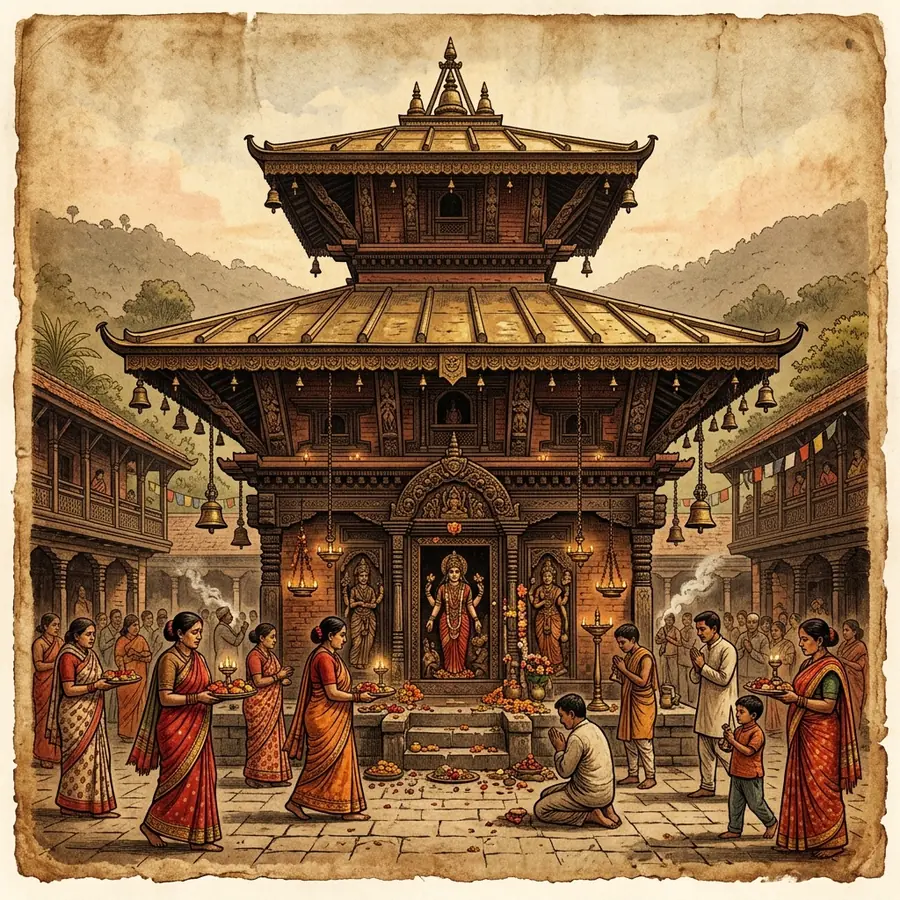
Malla period pagoda

Mahalaxmi Temple, Thankot

A two-storey Malla pagoda of about 1690 at the centre of the old Newar bazaar, free to enter, with Licchavi and medieval inscriptions in the precinct and a chariot jatra each Kartik.

Thankot Heritage Research Team Last checked August 2026 7 min read
The two-storey Mahalaxmi pagoda temple in Thankot with carved wooden struts
Two tiers of roof over the sanctum, in the Malla pagoda form.

The Mahalaxmi temple stands at the centre of old Thankot, a two-storey pagoda built around 1690 in the Malla style and still the working focus of the settlement around it. Entry is free, the courtyard is open from dawn until after dark, and thirty minutes is enough to see the temple, the carved struts under its roofs and the stone inscriptions set around the precinct.

This is the temple that gives Thankot its character as a Newar town rather than a highway suburb. The goddess Mahalaxmi is understood locally as the protector of the valley's western gate, the point every traveller from the south and west had to pass to enter Kathmandu, and the settlement grew up around her shrine rather than the other way round.

Come during the annual jatra, usually around Kartik Purnima in November or early December, and you will see the reason the temple still matters: wooden chariots carrying Mahalaxmi, Ganesh and Bhairab pulled by hand through the lanes, with the panche baja ensemble in front. Come on an ordinary weekday and you will have the courtyard largely to yourself.

How old is the Mahalaxmi temple?

The temple in its present pagoda form is generally dated to around 1690, placing it in the late Malla period, when the three valley kingdoms of Kathmandu, Patan and Bhaktapur were competing in temple building. The two-tiered roof, the brick and timber construction and the carved struts holding the eaves are all standard vocabulary of that period.

The site is older than the building. Inscriptions of the Licchavi period and of the medieval centuries survive in and around the precinct, which is the strongest available evidence that this has been a place of worship far longer than the current structure has stood. Nepali scholars have used these stones as source material for the settlement history of the western valley rim.

Local accounts connect the site to the older name for the settlement, Shonitapur, the town of blood, from the legend recorded in the vamshavali chronicle tradition. That connection is legend rather than documented history, and we treat it as such: the Shonitapur chronicle page sets out what the tradition says and what the record can actually support.

What to look at when you are there

The compound is small and easy to miss if you walk through it quickly. Four things repay a slower look.

  • The roof struts. The angled timbers that carry the eaves are carved with deities and supporting figures, cut from single pieces of hardwood. Look at how the carving continues onto surfaces that are barely visible from the ground.
  • The stone inscriptions. Set into walls and free-standing slabs around the precinct, in Sanskrit and old Nepali script. You will not read them without training, but their presence is the temple's documentary record.
  • The metalwork. The torana over the sanctum door, the bells, and the repousse work on the doorframe.
  • The bazaar around it. The lanes on the temple's flanks still hold brick houses with carved windows and low shopfronts. This is the surviving Newar core of Thankot.

The Mahalaxmi Jatra: when it happens and what to expect

Thankot's main festival is the Mahalaxmi Jatra, held around Kartik Purnima, the full moon of the month of Kartik, which normally falls in November or early December. The date moves with the lunar calendar, so check a current patro before travelling for it.

The core of the jatra is a chariot procession. Wooden chariots carrying Mahalaxmi, Ganesh and Bhairab are pulled by hand through the lanes of the old town over several days, accompanied by the panche baja, the five-instrument ensemble of shawm, drums and cymbals that leads Newar processions. Masked dancers appear in some years.

A separate Sindur Jatra, the vermilion festival, is also observed here, with red powder thrown over the crowd and the chariots. If you attend, wear clothes you do not mind ruining and keep a camera bagged.

Practical points for the jatra: the lanes are narrow and get very tight, the procession runs on its own schedule rather than a published one, and the best vantage points are the upper windows of houses along the route, which are for the families who live there. Stand where the locals stand, follow the crowd rather than pushing through it, and ask before photographing anyone carrying the chariot.

Etiquette at the temple

  • Shoes off before the shrine platform, as at any Newar pagoda.
  • Leather belts and bags are conventionally left with the shoes.
  • The inner sanctum is for worshippers. Non-Hindu visitors are welcome in the courtyard; do not step into the sanctum itself.
  • Photography of the building and the courtyard is fine. Photographing puja in progress, or the image of the goddess in the sanctum, is not. During the jatra, ask before photographing individuals.
  • Dress covered shoulders and knees. This is a residential neighbourhood as much as a monument.
  • Offerings. Flower and sindur trays are sold nearby. Small notes in the tray are the norm.

How long to spend and what else is close

Thirty minutes covers the temple properly. An hour lets you walk the surrounding lanes and stop for tea, which is the better use of the visit: the town around the temple is the point, and it is not visible from the highway.

The Mahalaxmi temple pairs naturally with the Thankot checkpoint and western gateway, ten minutes away on foot, and with Tribhuvan Park, about a kilometre further. Most visitors combine the temple with the cable car and treat it as the half hour before or after the ride, which works well because both start from the same part of town.

How to get to Mahalaxmi Temple

The temple is in the old core of Thankot, a short walk north of the Tribhuvan Highway checkpoint.

  • By bus or micro: anything running west from Kalanki towards Thankot or Naubise. Get down at the Thankot checkpoint and walk into the old bazaar; the pagoda roofs are visible from the lanes.
  • By taxi: ask for Thankot Mahalaxmi Mandir rather than Thankot alone, which drivers will read as the highway junction.
  • On foot from the cable car: the base station is roughly 1 km away, so the temple is an easy add-on either side of the ride.

Parking in the old lanes is difficult. Leave a vehicle near the highway and walk the last few hundred metres.

Questions

Common questions about Mahalaxmi Temple

The questions people search for most, answered with the figures we could verify.

When was the Mahalaxmi temple in Thankot built?
The present pagoda is generally dated to around 1690, in the late Malla period. The site is older than the building: Licchavi period and medieval inscriptions survive in and around the precinct, which indicates worship here long before the current structure was raised.
Is there an entry fee for the Mahalaxmi temple?
No. The courtyard is free and open to Nepali and foreign visitors from dawn until after dark. Shoes come off before the shrine platform, and the inner sanctum is reserved for worshippers.
When is the Thankot Mahalaxmi Jatra held?
Around Kartik Purnima, the full moon of the month of Kartik, which normally falls in November or early December. The date shifts each year with the lunar calendar, so check a current Nepali patro. A separate Sindur Jatra, the vermilion festival, is also observed here.
How long do you need at the Mahalaxmi temple?
Thirty minutes covers the temple itself. Allow an hour if you want to walk the surrounding lanes of the old Newar bazaar, which hold the brick houses and carved windows that give Thankot its character and are not visible from the highway.
Can non-Hindus visit the Mahalaxmi temple?
Yes. Unlike Pashupatinath, there is no restriction on non-Hindu visitors entering the courtyard. The inner sanctum is for worshippers only. Dress with shoulders and knees covered, remove shoes at the platform, and do not photograph puja in progress.

Planning a visit to Mahalaxmi Temple?

Fares, bus routes, journey times and the months when the western rim is at its clearest.