Chariot Festival

Mahalaxmi Jatra, Thankot: Dates, Sindur Throwing and What to Expect

Three days of fire rituals, fasting and chariot pulling through old Thankot, ending in streets turned red with vermilion.

Thankot.com Editorial Desk Last checked 31 August 2026 8 min read

The Mahalaxmi Jatra is Thankot's own chariot festival, held over three days that begin on Kartik Shukla Chaturdashi and close on the first day of the dark fortnight of Mangsir. In practice that puts it in the second half of November or the first days of December, and because it is fixed by tithi rather than by the Gregorian calendar, the dates move every year.

Nepali name: महालक्ष्मी जात्रा. Falls in Kartik into Mangsir (Kartik Shukla Chaturdashi to Mangsir Krishna Pratipada), usually late November, sometimes running into the first days of December. The Gregorian date moves every year with the lunar calendar, so confirm against a current Nepali calendar before you travel.

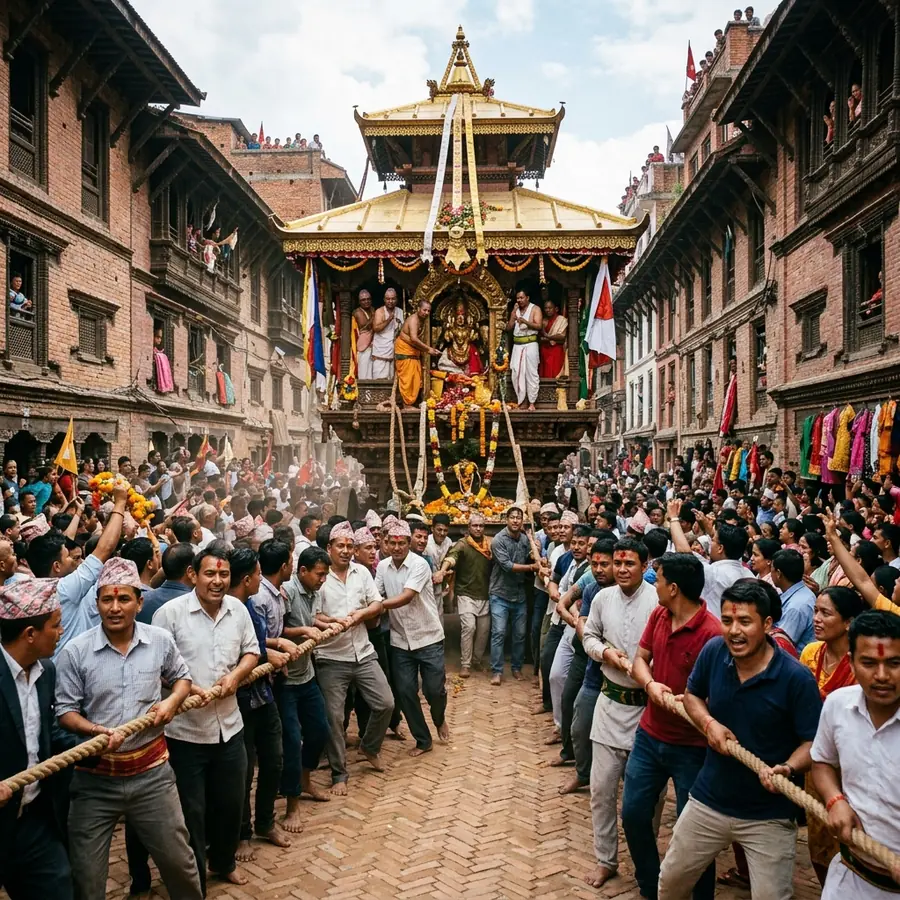
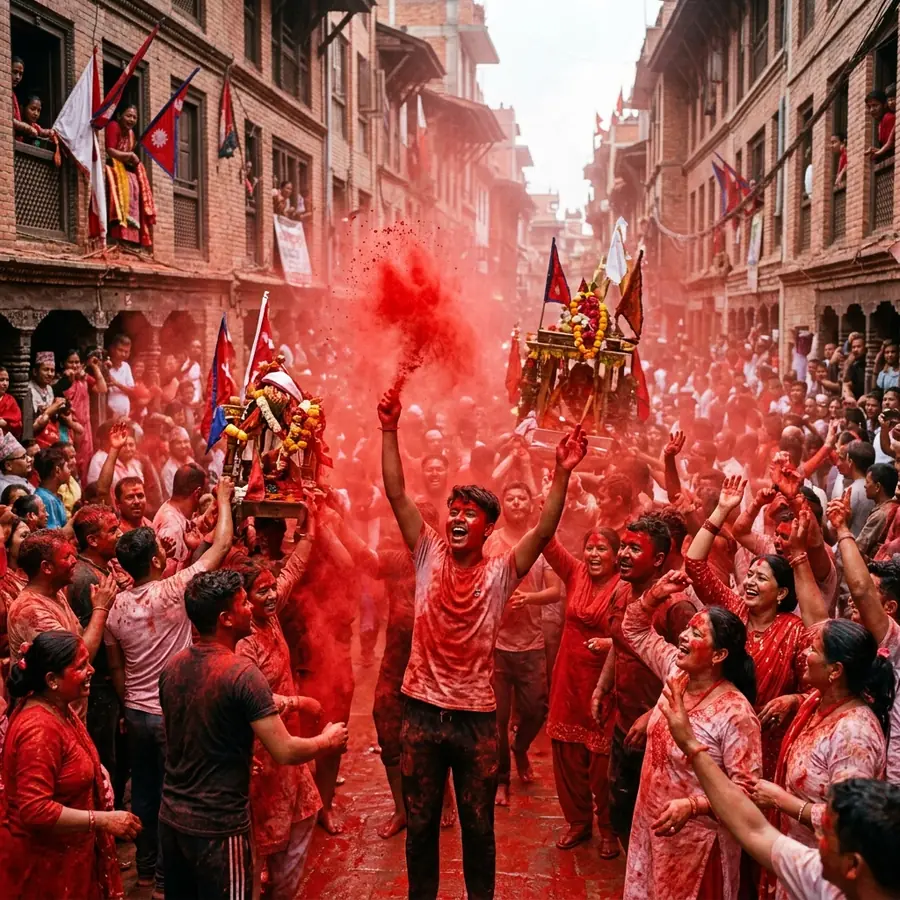
Crowds around the Mahalaxmi chariot during the Thankot jatra

3 days

Festival length

8

Bearers per khat

c. 1690

Temple built

12 km

West of Kathmandu

When does the Thankot Mahalaxmi Jatra take place?

The festival runs for three days. It opens on Kartik Shukla Chaturdashi, the fourteenth day of the bright fortnight of Kartik, which is also observed across Nepal as Baikuntha Chaturdashi. The second day falls on the Kartik full moon. The third and largest day is Mangsir Krishna Pratipada, the first day of the dark fortnight that opens the month of Mangsir.

In the Gregorian calendar that almost always lands in the second half of November. In some years the tithi slips far enough that the closing procession falls in the first days of December. There is no fixed Western date and anyone who gives you one has guessed. The day is set each year by the Nepali panchanga (the astronomical almanac) and confirmed locally by the temple guthi (the hereditary trust that funds and runs the festival). If you are planning a trip around it, ask the Mahalaxmi Temple committee or Chandragiri Municipality a few weeks ahead rather than trusting a date printed in English.

One practical note. Because the festival is anchored to Kartik Purnima, it sits about a month after Dashain and roughly a fortnight after Tihar. If you are already in the Kathmandu Valley for the autumn festival season, Thankot's jatra is the one that comes last, when the visitor crowds have thinned and the crowd on the street is overwhelmingly local.
What happens on each of the three days

Day one: the invocation

The first day is quiet by comparison and is mostly ritual work inside and immediately around the temple. Priests perform hom (a fire offering into a consecrated pit) to invite the deities into the images that will travel. Household offerings are brought through the afternoon. If you want to see the temple architecture and the woodwork without a crush of people, this is the day to come.

Day two: the full moon and the fast

The Kartik full moon is a day of worship and fasting for many families in the old settlement. Queues form at the Mahalaxmi shrine from early morning. Oil lamps are lit along the temple platform after dark. Food stalls set up along the approach road, and this is usually when the Langur Burja and card tables appear at the edges of the fairground, which is a Nepali festival fixture rather than anything specific to Thankot.

Day three: the procession

This is the day people mean when they say they are going to the jatra. The images are placed on khat (shoulder-borne wooden palanquins), eight bearers to each, and carried out of the temple compound in the early afternoon. The procession works through the old neighbourhoods of the settlement, halting at each for offerings, and takes in the Badrinarayan shrine before finishing at the Bhairab site the community calls Champo, where the closing rites are performed. It can run well past dark.

Why is it also called the Sindur Jatra?

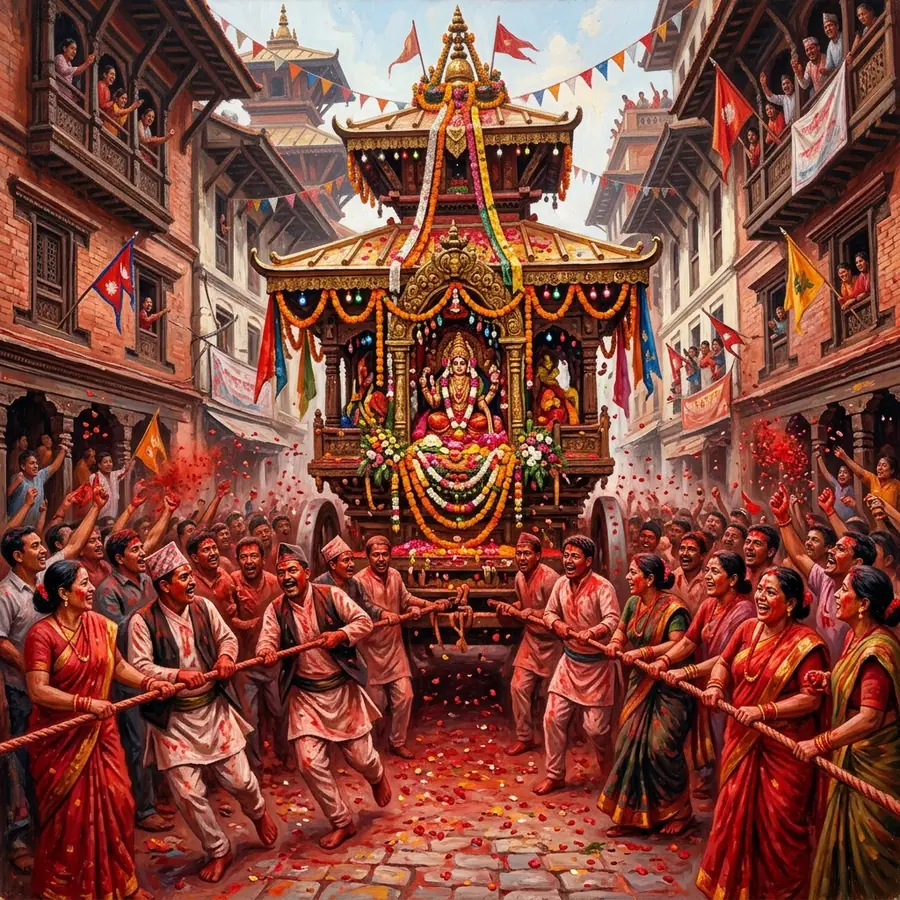
Sindur is the orange-red vermilion powder used in Hindu worship across South Asia, the same powder applied to the parting of a married woman's hair and to the forehead after receiving tika. At Thankot it is not applied politely with a fingertip. As the khat is danced through the lanes, handfuls of it go up over the bearers and over everyone within reach. By the time the procession reaches the far end of the bazaar the road surface, the walls, the bearers and most of the crowd are red.

The throwing is celebratory rather than solemn. Local accounts frame it as the community sharing in the blessing being carried past, and as an old harvest-season release after the rice is in. Thimi in Bhaktapur holds a much-photographed sindur festival in spring, and visitors sometimes conflate the two; Thankot's is a separate, autumn observance tied to its own Mahalaxmi shrine.

If you come, assume every item of clothing you are wearing is a write-off. Vermilion does not wash out of white cotton.

The music: what you will actually hear

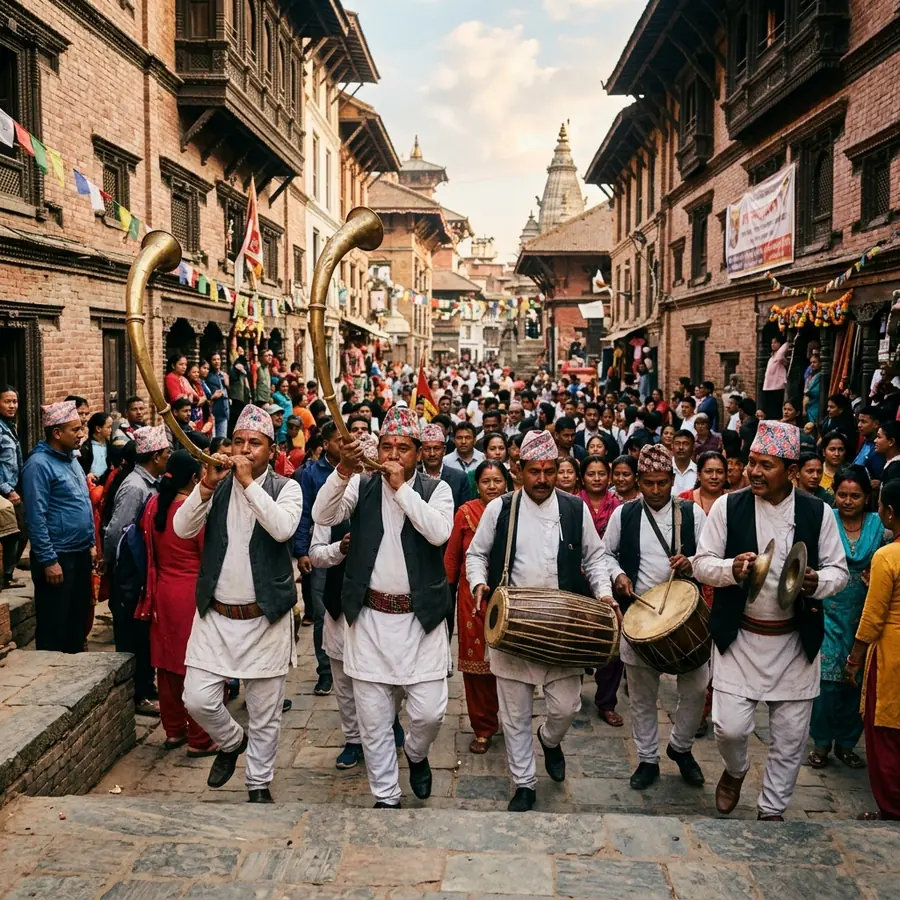
The procession moves at the pace the musicians set, which is why the khat appears to dance rather than simply advance. Two traditions overlap here. The Newar ensemble supplies the dhime (a large barrel drum slung at the waist and struck with one hand and one stick) and the bhusya (heavy cymbals), and it is the dhime that drives the swaying step of the bearers.

Alongside it you will hear the panche baja, the five-instrument ensemble of shawms, natural trumpets, kettledrums and cymbals that accompanies auspicious processions across the hills of Nepal. Its piercing sahanai shawm line is the sound most visitors remember afterwards. The two ensembles do not play in unison; they take the procession in turns, and the handover between them at a halt is worth waiting for.

Which deities are carried, and why those three?

Mahalaxmi is the presiding goddess of the settlement, worshipped as the giver of prosperity, health and good fortune. Her temple in the old bazaar, generally dated to around 1690, is the anchor of the whole event and of Thankot's religious life the rest of the year. You can read the temple's own story on our Mahalaxmi Temple page.

Ganesh travels because no Nepali procession begins without him. As the remover of obstacles he is invoked first, and his khat leads. Bhairab, the fierce protective form of Shiva, closes the sequence; the procession's final rites are performed at his site. Narayan is honoured at the Badrinarayan shrine along the route rather than carried, which is why local descriptions of the jatra sometimes list four deities and sometimes three.

That grouping, a prosperity goddess flanked by an opener and a protector, is a very old Kathmandu Valley pattern. It says something about how the settlement understood itself: a trading and farming village at a mountain pass that needed both luck and a guard.

Getting there, and where to stand

Thankot sits about 12 km west of central Kathmandu on the Tribhuvan Highway, at the foot of the Chandragiri ridge. Local buses and micros run from Kalanki throughout the day, and ride-hailing will bring you from Thamel in roughly 40 minutes off-peak. On procession day the highway approach and the bazaar road are effectively closed to vehicles from early afternoon, so plan to be dropped at the edge of the settlement and walk in. Our guide to getting to Thankot has the current routes and fares.

For the procession, the two good positions are the temple forecourt before the khat leaves, and any raised step or shopfront plinth along the bazaar lane. Do not try to follow the khat through the narrow sections; the crowd moves as one body and you will not be able to stop. Upper-floor windows along the route belong to households who have friends and relatives in them, so ask before you assume.

Come earlier than you think. The procession's stated start time is elastic and the interesting preparation, the dressing of the khat and the assembly of the musicians, happens in the hour before.

How to behave as a visitor

  • Wear something you are willing to destroy. Dark colours. Leave anything white at home.
  • Protect your camera. Vermilion is a fine powder and it gets into lens barrels and phone ports. A cheap plastic bag with a hole cut for the lens is what local photographers use.
  • Do not step in front of the khat. The bearers cannot see well and cannot stop. Photograph from the side or from behind.
  • Ask before photographing individuals, particularly during the fasting day and around the offerings at the temple. Wide crowd shots are fine.
  • Remove shoes where you see others doing so at shrine platforms. Leather belts and bags are still best left outside inner sanctums.
  • Accept the sindur. If someone reaches over to mark your forehead, it is meant kindly. Refusing visibly reads as a rebuff.
  • Do not drink alcohol in the procession. This is a temple event, not a street party, whatever the volume suggests.

In pictures

Wooden khat carried on shoulders through the Thankot bazaar
The khat is carried on shoulders, eight bearers to a palanquin, not rolled on wheels.
Vermilion powder thrown over the crowd during Sindur Jatra at Thankot
The vermilion gives the festival its second name, Sindur Jatra.
Musicians playing traditional instruments ahead of the Thankot chariot
Drums, cymbals and horns lead the procession and set the pace of the dance.
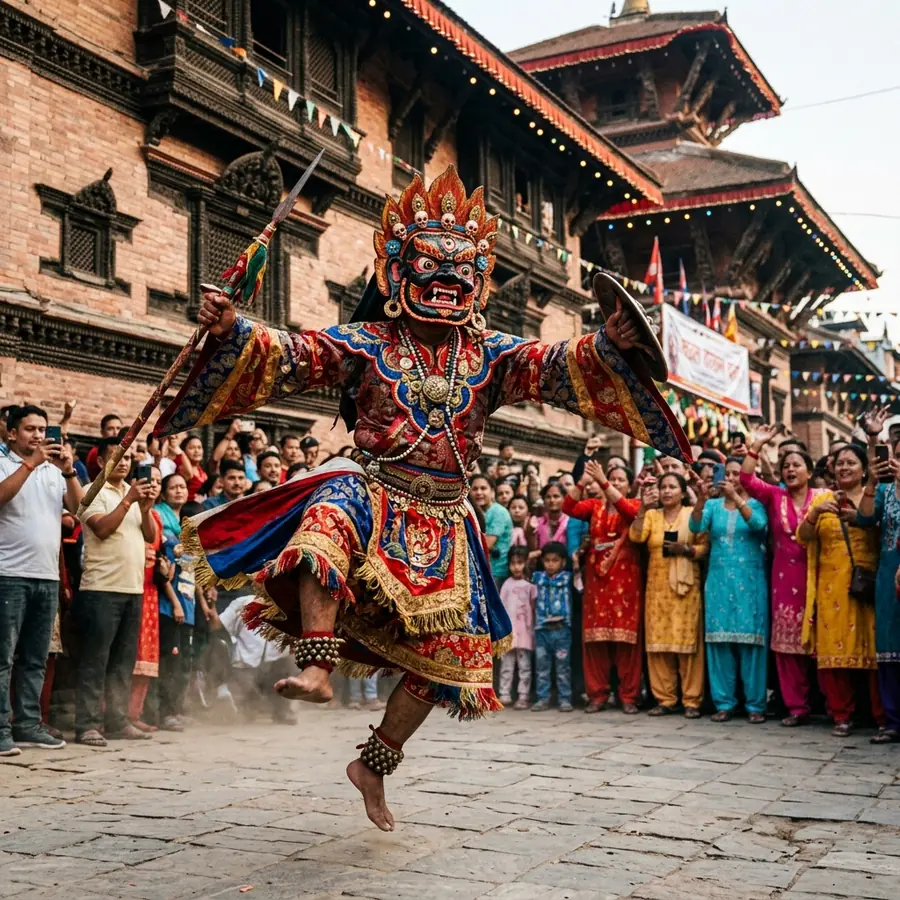
Masked dancer performing during the Thankot Mahalaxmi Jatra
Masked dance troupes perform at set halts along the route.

Common questions about Mahalaxmi Jatra

The questions people actually search for, answered plainly.

What date is the Mahalaxmi Jatra in Thankot this year?
There is no fixed Gregorian date. The festival runs for three days from Kartik Shukla Chaturdashi to Mangsir Krishna Pratipada, which usually falls in the second half of November and occasionally slips into early December. The exact day is set annually by the Nepali panchanga and confirmed by the Mahalaxmi Temple guthi, so check locally a few weeks ahead.
Why is the Thankot festival called Sindur Jatra?
Because of the vermilion. As the palanquins are danced through the old bazaar, handfuls of sindur powder are thrown over the bearers and the crowd until the lane, the walls and almost everyone in it are red. Sindur is the same orange-red powder used in daily Hindu worship, so the throwing is understood as sharing the blessing being carried past.
Which gods are carried in the Thankot jatra?
Mahalaxmi, the presiding goddess of the settlement, travels with Ganesh leading as the remover of obstacles and Bhairab as the protector, at whose site the closing rites are held. Narayan is honoured at the Badrinarayan shrine along the route rather than carried, which is why some local accounts list four deities.
Can foreign visitors attend the Mahalaxmi Jatra?
Yes. It is a public street festival with no ticket and no restriction on outsiders. Behave as you would at any working temple: keep out of the path of the palanquin, ask before photographing individuals, remove your shoes where others do, and wear clothes you do not mind ruining with vermilion.
Are the chariots pulled with ropes like the Rato Machhindranath rath?
No. Thankot uses khat, shoulder-borne wooden palanquins carried by about eight bearers each, rather than the tall wheeled rath pulled by rope in Patan and Bhaktapur. That is why the Thankot procession can move through narrow bazaar lanes and why it appears to dance in time with the drums.
Is the Thankot Sindur Jatra the same as the one in Thimi?
No, they are separate festivals. Thimi in Bhaktapur holds its well-known sindur festival at Nepali New Year in spring. Thankot's vermilion procession belongs to its own Mahalaxmi Jatra in the Kartik to Mangsir period, in late autumn.

Keep reading

Temples, chronicles and practical guides connected to this festival.

Plan the trip around the festival

Bus routes from Kalanki, cable car fares up Chandragiri, and which months give the clearest air.