Shiva temple

Bhaleshwor Mahadev Temple

The Shiva shrine on the Chandragiri summit at 2,551 m, free to enter and five minutes from the cable car station. Legend, ritual etiquette and the best months for the mountain view.

Thankot.com Editorial Desk Last checked August 2026 8 min read
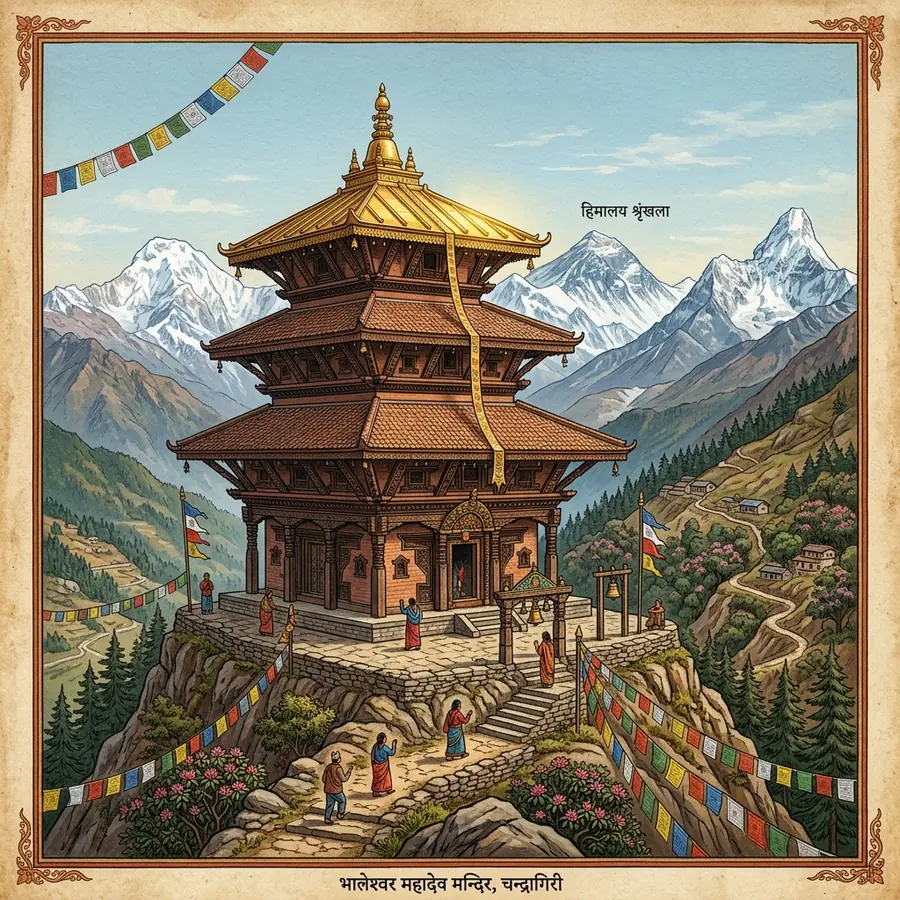
The Bhaleshwor Mahadev pagoda temple on the Chandragiri summit ridge at dusk
The shrine on the summit ridge, a short walk from the cable car top station.

Bhaleshwor Mahadev is a Shiva temple on the summit ridge of Chandragiri Hill at 2,551 m, roughly 12 km south west of central Kathmandu. There is no entry fee and no ticket for the shrine itself, it opens at first light and closes around dusk, and almost every visitor arrives the same way: the Chandragiri cable car from Thankot, then about five minutes on foot from the top station.

The temple is a working shrine rather than a monument. Priests perform daily puja, families come to make offerings for a wish or for a family member who is ill, and during the Nepali month of Magh, when the Swasthani Brata Katha is read across the country, the courtyard is busy from early morning. Shoes come off before you step onto the shrine platform, and leather belts and bags are usually left with them.

The other reason people climb the hill is the horizon. On a clear morning between October and February the terrace beside the temple looks north over the Kathmandu Valley to the Ganesh Himal, Langtang and Dorje Lakpa groups, and south west over the ridges towards Chitlang and the Mahabharat range.

The legend of Sati's forehead

According to the Puranic tradition that local temple accounts follow, Sati, the first consort of Shiva, took her own life at her father Daksha's fire sacrifice after he insulted her husband in front of the assembled gods. Shiva carried her body across the world in grief, and as he walked, parts of it fell to earth. Each place where a part landed became a shrine.

Bhaleshwor marks the spot where, in this telling, Sati's forehead fell. Bhala is the forehead, and Bhaleshwor is read locally as the lord of that place. This is legend rather than documented history: the story explains the site's standing among pilgrims and gives the temple its name, but it is not a dated record of when a shrine was first built here.

What can be said more plainly is that a high point on the western rim of the valley, visible from a large part of the Kathmandu basin, is exactly the kind of place that attracts a Shiva shrine, and that Chandragiri has carried religious and strategic weight for centuries. The Gorkhali campaign of the 1740s to 1760s used the same ridge as an observation point over the valley it was besieging.

What the temple looks like and how to behave there

The shrine sits in a walled compound on the ridge, with a metal-roofed pagoda over the sanctum, a line of bells that visitors ring on the way in, and stone paving that gets cold underfoot in winter. It is small. Ten minutes will cover the whole compound if you are only looking.

Practical etiquette

  • Shoes off before stepping onto the shrine platform. There is a rack, and in winter a pair of socks is worth having.
  • Leather belts, bags and jackets are conventionally removed along with the shoes. In practice most visitors are not challenged, but following the convention is the polite thing.
  • Dress covered shoulders and knees. Nobody will turn you away in shorts, but you will stand out among the pilgrims.
  • Photography is fine in the courtyard and of the exterior. Photographing the inner sanctum or the linga is not, and photographing people mid-ritual without asking is not. If someone is praying, wait.
  • Offerings of flowers, red powder, milk and incense are sold by stalls near the path. There is no fixed price for the tray; small notes are normal.
  • Non-Hindu visitors are welcome in the compound. Unlike Pashupatinath, there is no restriction on entering the courtyard.

When to go for the mountain view

Visibility, not weather, is the thing to plan around. The best window is late October through February, when the monsoon dust has been washed out and the air over the valley is at its clearest. Within that window, the first two hours after sunrise are consistently better than the middle of the day, because haze and cloud build from mid-morning.

From March the air thickens with dust and, later, with smoke from field burning, and by May the northern horizon is often gone entirely. During the monsoon, from June to September, the ridge spends much of its time inside cloud. That is not a wasted trip if you have come for the temple, and the forest on the way up is at its greenest, but do not count on seeing a mountain.

Snow reaches the ridge in some winters, normally in January or February. It rarely lasts more than a day or two, and when it comes the cable car queue in Thankot grows very long very quickly.

Getting up: cable car or on foot

Two routes, and they suit different visitors.

By cable car

The Chandragiri cable car covers 2.4 km from the base station in Thankot to the top station in nine to twelve minutes. A return ticket runs roughly NPR 800 to 900 for Nepali adults and around USD 22 to 23 for foreign nationals, with the line normally running from about 9am to 7pm. From the top station the temple is a short, gently rising walk on a paved path with a few flights of steps.

On foot

The hiking trail climbs roughly 4 km from the Thankot side and takes two to four hours. It is the older way up, and it is still what many pilgrims do, particularly during Magh. Walking up and buying a single downhill cable car ticket is a common compromise.

If you want to be at the temple for sunrise, the ridge hotels are the only realistic option, since the cable car does not run early enough for a dawn arrival.

Swasthani, Shivaratri and the festival calendar

Two periods change the character of the site completely.

Magh, roughly mid-January to mid-February. Through this month the Swasthani Brata Katha is read in households across Nepal over 30 days, and many readers and fasting observers make a pilgrimage to a Shiva shrine during it. Bhaleshwor is one of the sites that draws them, and the courtyard is busy from early morning throughout the month.

Mahashivaratri, on the fourteenth night of the dark fortnight of Falgun, usually late February or early March. The great night of Shiva is the single busiest day in the year at any Shiva temple in Nepal. Expect long queues at the cable car and a full compound.

Both dates move with the lunar calendar, so check a current Nepali patro, the almanac calendar, before planning around them. If crowds are what you want, go then. If they are not, avoid those weeks and go on a weekday morning instead.

Practical notes for the summit

  • Temperature. The ridge runs roughly 8C to 10C colder than the valley floor, and the wind makes it feel colder. Take a windproof layer in any season.
  • Food. Restaurants and tea stalls sit near the top station at resort prices. Nothing is sold at the shrine itself beyond offering trays.
  • Toilets. Available at the top station complex rather than at the temple.
  • Cash. Small rupee notes for offerings, tea and the stalls. Cards work at the cable car counter, not at the stalls.
  • Time needed. One to two hours on the ridge covers the temple, the viewpoint and a tea. Three to four hours covers the whole outing from the base station.

How to get to Bhaleshwor Mahadev

Every route to Bhaleshwor Mahadev starts in Thankot, 12 km west of central Kathmandu on the Tribhuvan Highway.

  1. Reach Thankot. Buses and micros run west from Kalanki towards Thankot and Naubise for a fare well under NPR 50. A taxi from Thamel or the Ring Road costs into the low thousands of rupees. Full detail is on the getting there page.
  2. Get to the base station. It is about 1 km uphill from the Thankot checkpoint. Shared jeeps run the last stretch, or walk it in fifteen minutes.
  3. Ride or walk up. Cable car, nine to twelve minutes, or the trail, two to four hours.
  4. Walk to the temple. Five minutes on a paved path from the top station, with a few flights of steps near the compound.
Questions

Common questions about Bhaleshwor Mahadev

The questions people search for most, answered with the figures we could verify.

Is there an entry fee for Bhaleshwor Mahadev temple?
No. The temple itself is free to enter for Nepali and foreign visitors alike. What costs money is getting to the ridge: a return cable car ticket is roughly NPR 800 to 900 for Nepali adults and around USD 22 to 23 for foreign nationals. Offerings are optional and unpriced.
What are the Bhaleshwor Mahadev temple timings?
The shrine itself opens at first light and closes around dusk, but for most visitors the real constraint is the cable car, which runs from about 9am to 7pm. If you want to be at the temple at sunrise you need to walk up or stay in one of the ridge hotels.
Why is Bhaleshwor Mahadev considered sacred?
According to the Puranic tradition followed by local temple accounts, the forehead, or bhala, of Sati fell at this spot as Shiva carried her body across the world after her death at Daksha's sacrifice. That legend gives the shrine its name and its standing among pilgrims. It is legend rather than a dated historical record.
Do I need to remove my shoes at Bhaleshwor Mahadev?
Yes. Shoes come off before you step onto the shrine platform, and leather belts and bags are conventionally left with them. There is a rack. In winter the stone is very cold, so a pair of socks is worth carrying.
Can you take photographs at Bhaleshwor Mahadev?
The courtyard, the exterior of the pagoda and the mountain view are all fine to photograph. The inner sanctum and the linga are not, and people mid-ritual should be asked first. If someone is praying at the shrine, wait rather than shooting past them.
When is Bhaleshwor Mahadev busiest?
Through the Nepali month of Magh, roughly mid-January to mid-February, when the Swasthani Brata Katha draws fasting observers, and on Mahashivaratri in late February or early March. Saturdays year round are busy with day trippers. A weekday morning is the quietest time to visit.

Planning a visit to Bhaleshwor Mahadev?

Fares, bus routes, journey times and the months when the western rim is at its clearest.