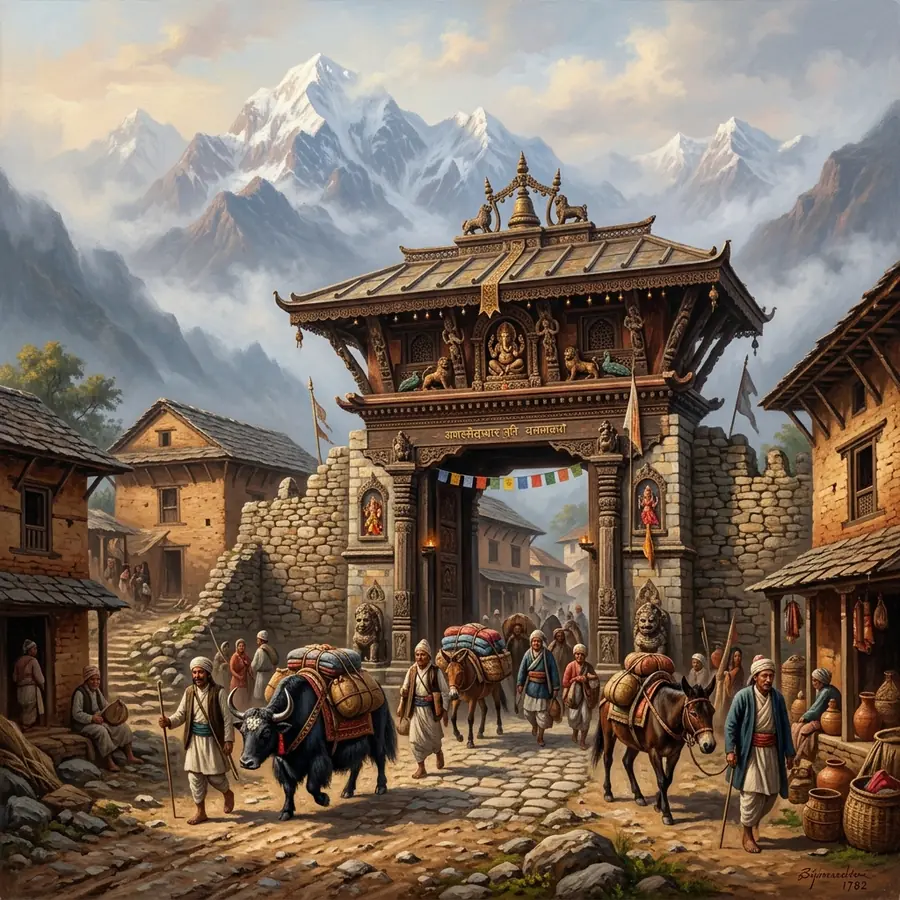
Historic gateway

Thankot Checkpoint and Western Gateway

The pass where the Tribhuvan Highway enters the Kathmandu Valley, guarded as a fort, a customs post and a police check in turn. Free to walk, ten minutes from the Mahalaxmi temple.

Thankot Heritage Research Team Last checked August 2026 6 min read
The gateway arch at the Thankot checkpoint on the western approach to Kathmandu
The western gate of the valley, on the Tribhuvan Highway.

The Thankot checkpoint is the point at which the Tribhuvan Highway crosses the western rim of the Kathmandu Valley, and every vehicle coming into the valley from India, from Pokhara and from the whole western half of Nepal passes through it. There is no ticket and nothing to book: it is a working road post, and the interest is in what it is rather than what it displays.

That interest is considerable. The same gap in the hills has been controlled as a fort, a customs post, a military garrison and a police check over a very long stretch of the valley's history. Local accounts derive the name from than, a place or shrine, and kot, a fort, which reads as the fort at the holy place. Under Prithvi Narayan Shah in the eighteenth century the settlement was established as a garrison and checkpoint on the trade route towards India.

For a visitor the practical value is that everything else in Thankot is within walking distance of this junction. The Mahalaxmi temple and the old Newar bazaar are ten minutes north, Tribhuvan Park is about a kilometre away, and the cable car base station is a kilometre uphill.

What the name Thankot means

The commonly given derivation is from than, a shrine or a place, and kot, a fort, giving something close to "the fort at the shrine" or simply "small fort". That reading is consistent with what the site has always been used for, and it is the explanation offered by local accounts and by most published descriptions of the town.

The settlement has an older name in the chronicle tradition: Shonitapur, read as the place of blood, from the legendary battle said in the vamshavali chronicles to have been fought here. That is legend, and we treat it as such on the Shonitapur page rather than presenting it as documented history. What can be said is that chronicles of the Kirat era refer to a settlement here, and that its position on the western pass gave it importance long before any of the surviving buildings were raised.

Why this gap in the hills mattered

The Kathmandu Valley is a bowl. Goods and armies could only enter it through a small number of passes, and the western pass at Thankot carried the traffic from the Indian plains and from the hill kingdoms to the west. Whoever held it held the valley's supply line.

That is precisely how the Gorkhali campaign of the 1740s to 1760s used it. Rather than assaulting the valley's three fortified cities directly, Prithvi Narayan Shah's forces, under commanders including Kalu Pande, worked to close the passes and strangle the valley's trade. Thankot was one of the points where that blockade bit. The unification chronicle sets out the sequence and how long it took.

After the conquest the town continued in the same role, as the last Nepali settlement on the trade route south and the place where merchants were checked, taxed and given protection for the road. The modern police checkpoint is a direct continuation of that function, several centuries on.

The cars that came over the hill

The most striking chapter in the gateway's history is the shortest. Before a motorable road crossed the rim, the Kathmandu Valley had cars but no way to drive them in. Vehicles were dismantled where possible, slung on poles and carried over the hills by teams of porters, then reassembled in the city.

The Tribhuvan Highway, the first road link between Kathmandu and the plains, opened in the 1950s and ended that practice. It runs through Thankot, which is why the checkpoint sits where it does. Anyone who has watched a loaded truck grind up the last bends towards the pass has some sense of what the porters were doing on the same gradient without an engine.

The car porters page tells that story properly, with what is documented and what is remembered.

What there is to see today

Be clear about expectations: this is a road junction with a police post, not a preserved monument. What you can do is walk it and read the landscape.

  • The gateway arch and the pass itself. Stand where the road crosses the rim and you can see why this gap and no other carried the traffic.
  • The traffic. Long-distance buses, freight trucks off the Prithvi and Tribhuvan highways and the check queue. It is the valley's front door in operation.
  • The old bazaar, ten minutes north on foot, where the brick houses and carved windows of the Newar settlement survive around the Mahalaxmi temple.
  • The view back east over the valley floor from the higher ground above the junction.

Do not photograph the police post, personnel or security arrangements. Photographing the gateway, the road and the town is unremarkable and nobody will mind.

How to use the checkpoint as a base for the day

Because every westbound bus and micro from Kalanki stops here, the junction is the natural starting point for a day in the area. A workable order:

  1. Get down at the checkpoint in the morning.
  2. Walk north into the old bazaar for the Mahalaxmi temple, thirty minutes to an hour.
  3. Walk or take a shared jeep uphill to the cable car base station, ride up, and spend an hour or two on the ridge at Bhaleshwor Mahadev.
  4. Come down and finish in Tribhuvan Park if you have the afternoon, or head back to the city.

That sequence puts you on the ridge in the clearest part of the day and leaves the flat sites for the afternoon, which is the right way round for most of the year.

How to get to Thankot Gateway

The checkpoint is on the Tribhuvan Highway about 12 km west of central Kathmandu and roughly 3 km beyond the Ring Road at Kalanki.

  • By bus or micro: every westbound service from Kalanki towards Thankot, Naubise, Hetauda or Pokhara passes through. The fare from Kalanki is well under NPR 50 and the run takes twenty minutes to an hour depending on traffic.
  • By taxi: low thousands of rupees from central Kathmandu, and slow at rush hour through Kalanki.
  • Arriving from outside the valley: if you are coming from Pokhara or Chitwan by road, you will pass through this checkpoint whether you plan to or not.

The getting to Thankot guide has bus stands, fares and journey times by hour of day.

Questions

Common questions about Thankot Gateway

The questions people search for most, answered with the figures we could verify.

What does the name Thankot mean?
It is commonly derived from than, meaning a place or shrine, and kot, meaning a fort, giving something close to "the fort at the holy place" or simply "small fort". The reading matches the site's long use as a guarded pass into the Kathmandu Valley.
Why is there a checkpoint at Thankot?
Because the Tribhuvan Highway crosses the western rim of the Kathmandu Valley here, so every vehicle entering the valley from the west and south passes this point. The same gap has been controlled as a fort, a customs post and a garrison in earlier centuries, and the modern police check continues that function.
Is there anything to see at the Thankot checkpoint?
It is a working road junction rather than a monument, so the interest is in the setting: the pass itself, the traffic entering the valley, and the old Newar bazaar around the Mahalaxmi temple ten minutes north on foot. Allow twenty to thirty minutes at the junction itself.
Can you take photographs at the Thankot checkpoint?
Photographing the gateway, the road and the town is unremarkable and nobody will object. Do not photograph the police post, personnel or security arrangements. If in doubt, ask, or point the camera at the hills instead.
How far is Thankot from Kathmandu?
About 12 km west of the city centre and roughly 3 km beyond the Ring Road at Kalanki. Buses and micros from Kalanki take twenty minutes to an hour depending on traffic, for a fare well under NPR 50. A taxi from central Kathmandu costs into the low thousands of rupees.

Planning a visit to Thankot Gateway?

Fares, bus routes, journey times and the months when the western rim is at its clearest.