Mother's Day

Matatirtha Aunsi: Nepali Mother's Day at the Matatirtha Pond

Nepal's Mother's Day, kept at a spring-fed pond in Chandragiri where those whose mothers have died come to make offerings.

Thankot.com Editorial Desk Last checked 31 August 2026 7 min read

Matatirtha Aunsi is Nepal's Mother's Day, and it falls on the new moon of Baisakh, the first month of the Nepali year, which puts it in late April or the first half of May. It is kept everywhere in Nepal as Aama ko Mukh Herne Din (the day of looking upon your mother's face), but the name and the rites come from one specific place: the Matatirtha pond in Chandragiri Municipality, a short distance from Thankot.

Nepali name: मातातीर्थ औंसी. Falls in Baisakh (Aunsi, the new moon of Baisakh), late April or the first half of May. The Gregorian date moves every year with the lunar calendar, so confirm against a current Nepali calendar before you travel.

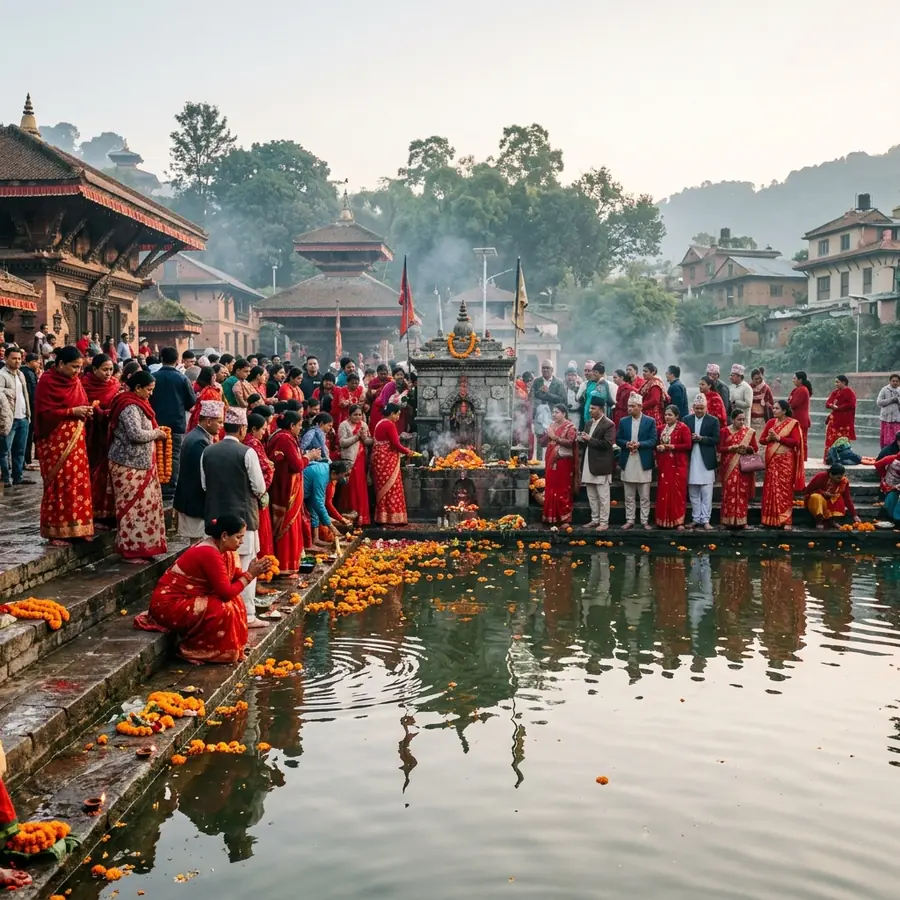
Pilgrims gathered at the Matatirtha pond on Mother's Day

Aunsi

New moon of Baisakh

1 day

Observance

4am

First arrivals

~5 km

From Thankot bazaar

When is Nepali Mother's Day?

Matatirtha Aunsi falls on aunsi, the new moon, in the Nepali month of Baisakh. Baisakh opens the Bikram Sambat year and runs from roughly mid-April to mid-May, so the observance lands in late April or the first half of May depending on the year. It is not fixed to a Gregorian day and it has nothing to do with the second Sunday in May observed in the United States and elsewhere.

Because it is a new moon rather than a full moon, the date sits close to the dark end of the lunar cycle, and the earliest pilgrims come to the pond in genuine darkness. If you intend to be there, confirm the day against a Nepali calendar for the current Bikram Sambat year rather than any English-language listing, which frequently gets it wrong by a day.
What people actually do on the day

The observance splits cleanly in two, and understanding that split is the whole point of the day.

If your mother is living, you visit her, bring sweets, fruit, new clothes or money as you can afford, touch her feet, and eat with her. Nothing about that requires a temple. Most of Nepal keeps Mother's Day at home, and the phrase aama ko mukh herne din, the day of looking upon your mother's face, describes exactly that.

If your mother has died, you come to a tirtha, a sacred water place, and make offerings for the peace of her soul. Matatirtha is the tirtha the day is named after. Pilgrims bathe or sprinkle themselves with water from the pond, offer flowers, rice, sweets and a lit wick, and many arrange shraddha, the memorial rite for an ancestor, performed by a priest at the site. It is a quiet, tearful gathering rather than a fair, and the mood at the pond edge at five in the morning is unlike any other festival in the valley.

The legend of the pond, told as legend

Local tradition holds that a herdsman grieving for his mother came to this spring, and that when he looked into the water he saw her face and received her blessing and her food. That story is why the site is called Matatirtha, the mother's sacred water, and why people whose mothers have died come here in particular.

We give it as tradition, not as documented history. There is no dated record establishing the origin of the observance and the versions collected in Chandragiri differ in detail; in some the mother's hand rises from the water, in others only her reflection appears. What is documented is that the site has functioned as a pilgrimage tirtha for a very long time and that its temple complex has been repeatedly rebuilt.

What the site is actually like

Visitors sometimes arrive expecting something on the scale of Pashupatinath. Matatirtha is not that. It is a small stone-lined pond fed by a hill spring, set in a walled compound with shrines around it, on rising ground below the Chandragiri ridge. On an ordinary day it is a calm, green, slightly overgrown place where you might be the only visitor. Our Matatirtha pond page covers visiting it outside the festival, which is honestly the more pleasant experience if you want to look at the site itself.

On Aunsi it is transformed. The approach road fills with parked vehicles and stalls selling flowers, wicks, sweets and photographs of deceased relatives to be garlanded. Queue lines are managed by volunteers and police. The water gets crowded quickly, and by mid-morning the pond edge is a slow-moving press of people.

Crowds, timing and getting in

Peak crush is roughly 6am to 11am. Devout pilgrims start arriving from about 4am and many families come straight after first light. If you want to see the rites without adding to the pressure, come very early, before about 6am, or come in the afternoon after about 2pm when the crowd thins noticeably and the priests are working through the remaining shraddha bookings.

Vehicle access on the day is restricted well below the site and traffic on the Thankot approach is heavy. Public buses run to the junction and the last stretch is on foot uphill. Allow far more time than the distance suggests. See our Thankot travel guide for the current bus routes from Kalanki, and our seasonal guide if you are choosing when in the year to come.

Baisakh weather is warm and increasingly humid, with the pre-monsoon build-up bringing afternoon cloud and occasional short storms. Bring water and a hat if you are queuing through the middle of the day.

How to visit respectfully

  • Recognise what you are attending. For many people at the pond this is a day of open grief. It is not an event to wander through with a camera raised.
  • Do not photograph people performing shraddha or crying, at all, unless they invite you. Wide shots of the compound are acceptable.
  • Do not enter the water unless you are performing the rite. It is a small pond and every person in it displaces someone who came for a reason.
  • Dress modestly. Covered shoulders and knees. This is a mourning observance as much as a celebration.
  • Take your rubbish out. Plastic wrappers from offerings are the site's biggest problem on the day.
  • If someone offers you prasad, the food returned from an offering, accept it with your right hand.

Why this festival matters to Thankot specifically

Matatirtha sits inside Chandragiri Municipality, the same local government unit as Thankot, on the western edge of the Kathmandu Valley where the land starts to climb towards the pass. That corner of the valley has an unusually dense cluster of water-linked sacred sites: Matatirtha's spring, the Indra Daha pond up at Dahachowk, and the ridge shrines above them. Read together they suggest a long-settled landscape in which springs at the foot of the hills were treated as thresholds between worlds.

For one day a year that quiet corner receives a national crowd. If you are staying in Thankot, Matatirtha Aunsi is the single easiest chance you will get to see a major Nepali observance at the place it is actually named after, rather than at a replica shrine in the city.

In pictures

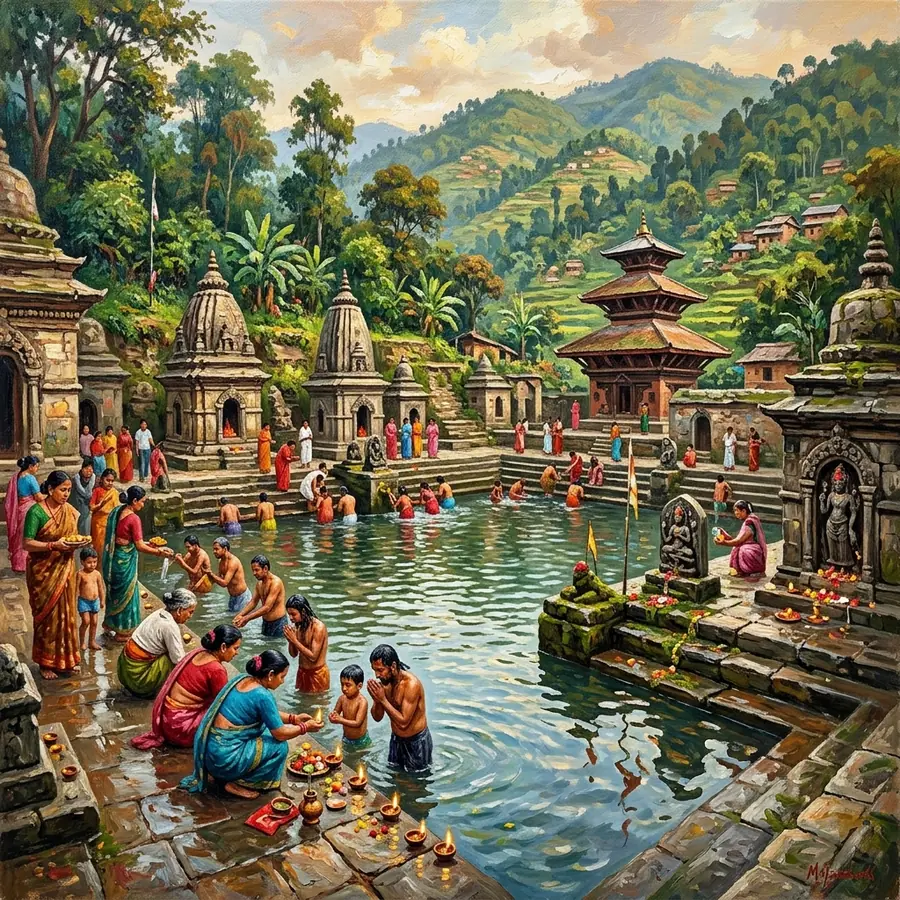
The stone-lined Matatirtha pond fed by a hill spring
The pond is small, stone-lined and fed by a hill spring. It is not a bathing tank in the Varanasi sense.

Common questions about Matatirtha Aunsi

The questions people actually search for, answered plainly.

When is Mother's Day in Nepal?
On the new moon, aunsi, of the Nepali month Baisakh, which falls in late April or the first half of May. The Gregorian date changes every year because it follows the lunar calendar, so it should be checked against a current Nepali calendar rather than assumed.
What is Matatirtha Aunsi?
It is Nepal's Mother's Day, also called Aama ko Mukh Herne Din, the day of looking upon your mother's face. People whose mothers are living visit them with gifts and food. People whose mothers have died travel to a sacred water site, most famously the Matatirtha pond in Chandragiri, to make offerings and arrange memorial rites.
Where is the Matatirtha pond?
In Chandragiri Municipality on the western edge of the Kathmandu Valley, a few kilometres from Thankot bazaar and roughly an hour from central Kathmandu in normal traffic. It is a small spring-fed stone pond inside a walled temple compound below the Chandragiri ridge.
How crowded is Matatirtha on Mother's Day?
Very. The heaviest crush runs from about 6am to 11am, with the first pilgrims arriving around 4am. Vehicle access is restricted well below the site and the last stretch is walked. Arriving before 6am or after 2pm makes the visit considerably easier.
Can I visit Matatirtha on a normal day?
Yes, and it is a much better way to see the site itself. Outside the festival the compound is quiet and often almost empty, and you can walk around the pond and the surrounding shrines without a queue.
Is Matatirtha Aunsi a public holiday in Nepal?
It is widely observed and many businesses close or run short hours, but it is not treated the same way everywhere. Government offices and banks follow the official holiday list for the Bikram Sambat year, so confirm rather than assume if your trip depends on offices being open.

Keep reading

Temples, chronicles and practical guides connected to this festival.

Plan the trip around the festival

Bus routes from Kalanki, cable car fares up Chandragiri, and which months give the clearest air.