Bathing Fair

Indra Jatra at Indra Daha: the Chandragiri Side of the Festival

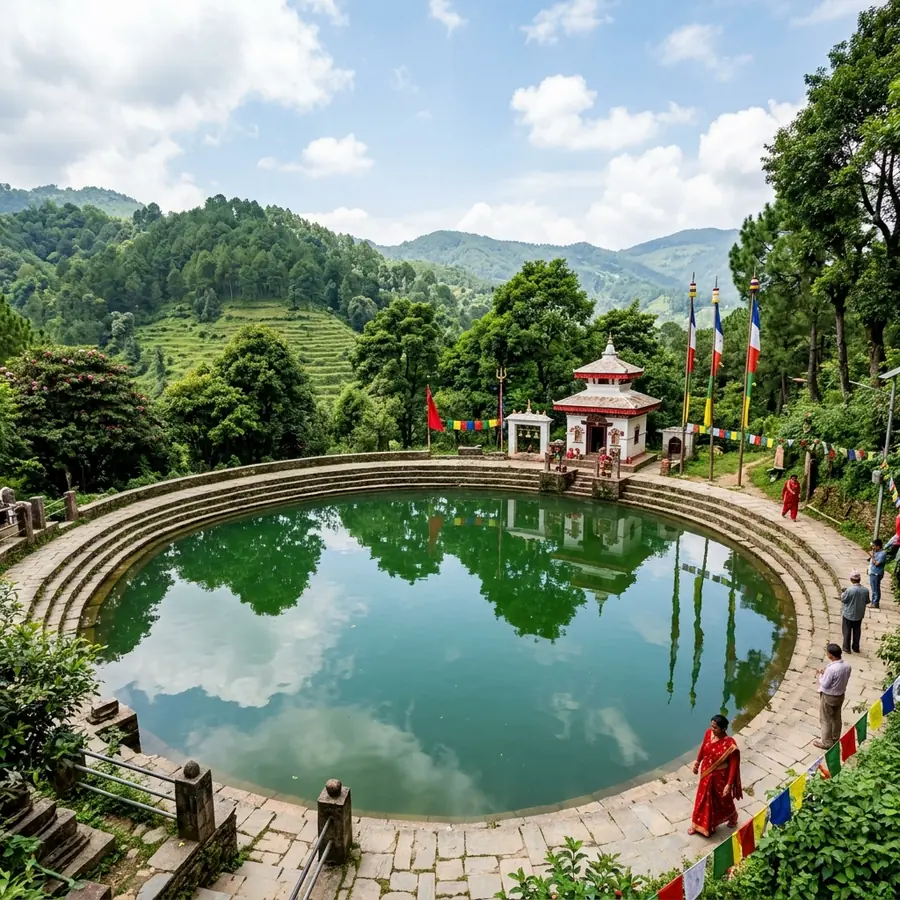
A hill pond above Dahachowk that the Indra Jatra legend names directly, with its own bathing fair on the Bhadra full moon.

Thankot.com Editorial Desk Last checked 31 August 2026 6 min read

Kathmandu's Indra Jatra is the valley's biggest street festival, held at Basantapur in the Nepali month of Bhadra, which spans mid-August to mid-September. What is much less known is that the legend behind it names a place in Chandragiri: Indra Daha, a pond in the hills above Dahachowk, roughly 5 km from Thankot, which keeps its own bathing fair on the Bhadra full moon.

Nepali name: इन्द्रदह जात्रा. Falls in Bhadra (Bhadra Shukla Purnima, the Bhadra full moon), late August or September. The Gregorian date moves every year with the lunar calendar, so confirm against a current Nepali calendar before you travel.

The Indra Daha pond in the hills above Dahachowk

Purnima

Bhadra full moon

5 km

From Thankot

8 days

Kathmandu Indra Jatra

Monsoon

Season on the day

What is Indra Daha?

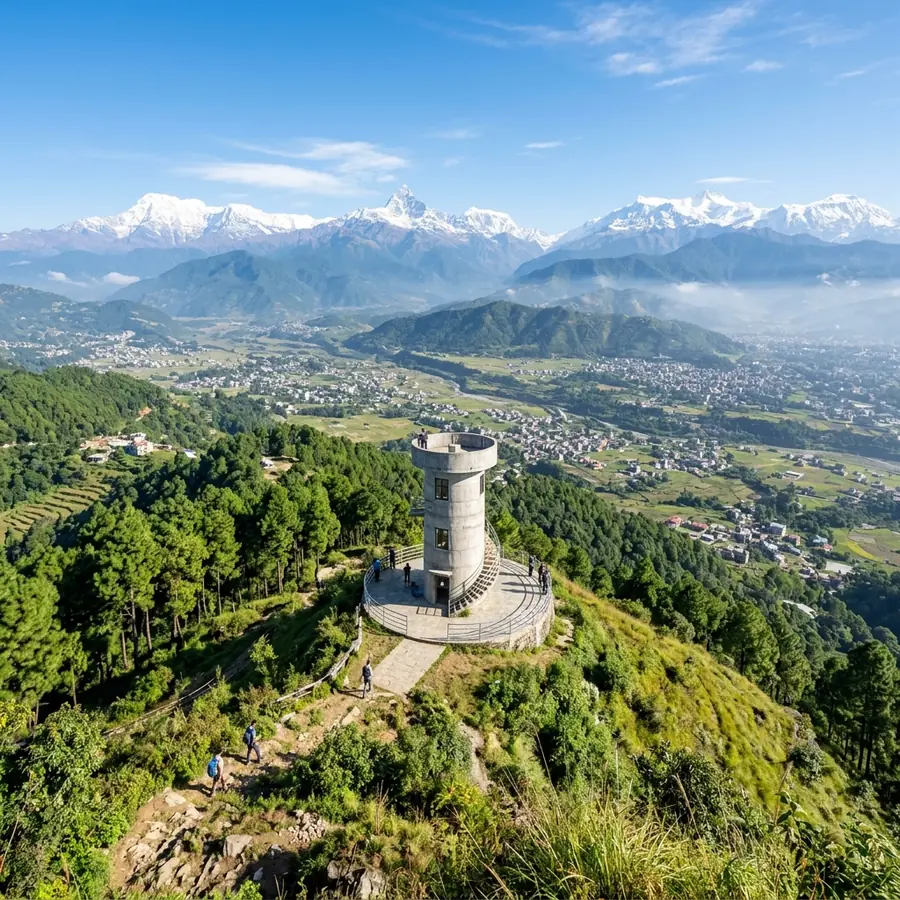
Indra Daha is a pond in the hills of Chandragiri Municipality, Ward 1, above the village of Dahachowk. Daha simply means pond or lake in Nepali, so the name reads as Indra's pond. It sits in green, terraced hill country roughly 5 km from Thankot bazaar and about the same again from Kalanki, and on a clear day the ridge above it offers one of the better panoramas of the western Kathmandu Valley.

For most of the year it is a quiet place used by walkers and by families from the surrounding wards. On the Bhadra full moon it becomes a tirtha, a bathing place, and a fair grows up around it.
The legend that connects it to Indra Jatra

Two strands of local tradition attach to the pond, and we give both as tradition rather than as record.

The older strand places Indra, king of the gods, descending to bathe here in the Satya Yuga, with his elephant tethered on a golden chain. That is the story that gives the pond its name.

The second strand connects directly to the festival Kathmandu keeps. In the Indra Jatra story, Indra comes down to the valley to gather parijat flowers for his mother and is caught and bound as a thief. His mother Dagini, sometimes called Basundhara, comes down looking for him, reveals who he is, and secures his release by promising the valley enough dew to carry the crops through the dry months. The valley people add a second condition: that the souls of their dead be taken to heaven. In the version told in Chandragiri, those souls follow Indra and his mother out of the city and westwards to Indra Daha, and enter the water there to make the passage.

That is why some Newar families still come to Indra Daha on the first day of Indra Jatra to bathe, and why the pond is regarded locally as the western terminus of a festival everyone else associates with Basantapur Durbar Square.

The Bhadra Purnima fair

The main local observance is on Bhadra Shukla Purnima, the full moon of Bhadra. A canopy is raised over the tank, priests attend, and devotees from Dahachowk, Thankot, Matatirtha and the surrounding wards come to bathe and make offerings. A mela (fair) sets up around it: food stalls, bangle and toy sellers, and the usual festival dice and card tables at the margins.

It is a modest, local event. Nobody should come expecting the scale of the Kathmandu Indra Jatra, with its Kumari chariot, Lakhey dancers and the raising of the great yosin pole at Basantapur. What Indra Daha offers instead is the older, quieter shape of the thing: a hill pond, a canopy, a few hundred people, and a story that predates the city version.

How to get to Indra Daha from Thankot

The straightforward route is by road to Dahachowk, then on foot. Buses and micros run from Kalanki towards Dahachowk through the day, and from Thankot bazaar it is a short hop plus a climb. Walking the whole way from Thankot takes most people between one and two hours depending on the route and the mud.

Bhadra is late monsoon. The trails are slick, the leeches are out in the damp sections, and the afternoon usually clouds over. Walking shoes with grip matter more than anything else you bring. The reward, on the mornings when it is clear, is a view north and east across the whole western half of the valley, with Kathmandu spread out below. Our interactive map shows the pond, the Dahachowk view tower and the ridge trails together.

Combining it with the rest of the western valley

Indra Daha works well as one stop on a longer day. From the Thankot side you can pair it with the Matatirtha pond, the other sacred water site of Chandragiri, and finish at the Bhaleshwor Mahadev temple on the Chandragiri ridge by cable car. Between them those three sites give you the whole vertical range of the local sacred landscape: spring, hill pond and summit shrine.

If you are here in Bhadra and want the full contrast, do the Indra Daha fair in the morning and take a bus into the city for the Basantapur celebrations in the afternoon. Seeing both in one day makes the relationship between them much easier to understand than reading about it.

The pond on an ordinary day

Most visitors will see Indra Daha outside the fair, and that is a different and in some ways better experience. Outside Bhadra the compound is quiet, the water is still, and the walk up from Dahachowk passes through terraced fields and small stands of pine. October and November, once the monsoon has cleared, give the best combination of green ground and clean air, and on those mornings the ridge above the pond shows the whole northern rim of the valley.

There is no ticket and no gate, and there are no facilities beyond whatever tea shop happens to be open in Dahachowk. Carry water and something to eat if you are making a morning of it. Local families use the ridge for picnics on public holidays, so a Saturday will be busier than a weekday, and the paths are shared with grazing animals rather than with other walkers.

The site has been steadily developed in recent years, with the Dahachowk view tower and improved trail sections drawing day trippers from Kathmandu who have never heard the Indra Jatra story attached to the water. That is worth knowing before you go: you may find people treating the pond as scenery. The bathing rite belongs to the fair day and to the first day of Indra Jatra, and outside those the pond is simply a quiet piece of water in a good landscape.

What to expect and how to behave

  • Do not swim. On the fair day the pond is in ritual use. Bathing is a rite here, not recreation.
  • Ask before photographing people bathing. Wide shots of the canopy and the fair are fine.
  • Bring cash in small notes. There is no card payment at a hill mela and change is scarce.
  • Carry your own water. Stall drinks are available but the walk up is warm and humid.
  • Take rubbish back down with you. There is no collection service on the ridge.
  • Start early. Monsoon cloud generally closes the view in by late morning.

In pictures

View tower on the ridge above Dahachowk
The ridge above the pond gives one of the best clear-day views over the western valley.

Common questions about Indra Jatra at Indra Daha

The questions people actually search for, answered plainly.

Where is Indra Daha?
In Chandragiri Municipality Ward 1, in the hills above the village of Dahachowk, roughly 5 km from Thankot bazaar on the western edge of the Kathmandu Valley. Access is by road to Dahachowk and then on foot uphill.
When is the Indra Daha fair held?
On Bhadra Shukla Purnima, the full moon of the Nepali month Bhadra, which falls in late August or September. The date shifts each year with the lunar calendar. Some Newar families also visit on the first day of the Kathmandu Indra Jatra.
How is Indra Daha connected to Indra Jatra?
Local tradition holds that when Indra was released after being caught taking flowers in the valley, the souls of the valley dead followed him and his mother westwards to Indra Daha and entered the water there to reach heaven. The pond is also said to be where Indra himself came down to bathe. Both are told as legend, not as documented history.
Is Indra Daha worth visiting outside the festival?
Yes, particularly in the clear autumn months after the monsoon. The pond is quiet, the walk up from Dahachowk is pleasant, and the ridge above it gives a wide view over the western valley. Combine it with the Dahachowk view tower.

Keep reading

Temples, chronicles and practical guides connected to this festival.

Plan the trip around the festival

Bus routes from Kalanki, cable car fares up Chandragiri, and which months give the clearest air.